Other Pages of Interest

Showing posts with label Transportation. Show all posts

Friday, February 10, 2012

The Matrix

In previous posts I have alluded to the fact that we are now the proud owners of a brand new 2006 Toyota Corolla (OK, so it's not brand new...).  It came with 50,000 kilometers, a 6-disk CD changer and AUTOMATIC transmission.  All items that I would have taken fore granted on a vehicle purchased in 2011 in the US, but pretty impressive stats for Buenos Aires.  It's been great so far, we have both been driving like old pros in this 'anything goes' environment, and though I hear my mother's gasp echoing in my head every time someone cuts across 4 lanes to make a righthand turn at a red light, I feel pretty confident behind the wheel.  So confidant, that we are going to test the limits of this Corolla's capacity by fitting the three of us, my in-laws, our luggage AND a jogging stroller next week when we drive 4 hours to the beach. But that post is for another day.

Today, I write about the parking situation for our little 4-door, a place that I have deemed, The Matrix.

Our apartment building lacks a parking garage, and we live on arguably the busiest street in Buenos Aires, so the only true option is to rent a space in a private garage.  We found a place, less than a block from our front door, that charges way too much - but is worth the convenience factor.  We pay every month, in cash, with no contract or exchange of information of any kind.  Also, they raise the price every 3 months.  Awesome.

Either way, it is the best option we have found so far.  It is also one of the most advanced garages I've ever seen (incredible, considering where we are), which is how it earned it's name.  There are 15 levels of parking spots, all of them one car deep.  This gives the cars the appearance of being in little pods.  Just like the movie, The Matrix.

 Here is how the garage works:

15 stories of parked cars - AKA The Matrix
  1. You walk up to the garage and signal to the guy sitting in a glass booth.  This guy is smoking and drinking mate 100% of the time.  No exaggeration.
  2. He ascends on what can be best described as a "car-elevator" and locates your car.  If he's in a bad mood, he asks for your license plate number (which you have no clue of) so you hand him your keys and he presses unlock until your car beeps.  
  3. He proceeds to use a mechanical arm that extends out from the car-elevator to pull your car out of the "pod" it was parked in.
  4. He descends to the ground level.
  5. The mechanical arm again grabs your car and rolls it onto a round platform. 
  6. The round platform rotates (like a new car showroom), thus alleviating your need to turn the car around to get out of the garage.
Our car being lifted onto the platform

It's pretty cool.  There has only been one hiccup. Thiswas when the mechanical arm broke and I had to ride with the guy in the car elevator in order to drive the car from the parking spot onto the elevator.  This combines virtually all of my height fears into one: being up high and seeing through the floor (the floor of the elevator is a metal mesh), driving while being able to see through to the ground and having to walk while up high and being able to see the ground.  Now that I write it, it sounds like I just don't like being able to see the ground from up high - either way, it was super scary, and then incredibly humiliating when I was frozen (due to fear) and couldn't explain myself to the garage-man (due to fear erasing all of my Spanish knowledge).  He kept asking "Is this not your car??", and I had to tell him that yes, this was my car, but I could not physically walk to it.  Super embarrassing.  The positive side of this day?  I got to tell Jon that there was a glitch in The Matrix, and felt clever until I explained the rest of the story.

Thursday, October 27, 2011

I Do It Myself

Along with this new world of mothering comes a plethora of books and information on what your child is doing, what they should be doing, what they are no longer doing and, finally, what they will do.  One of the phases in our near future is the inevitable "I do it myself!" phase, in which your child wants to take control, assert leadership, and do simple tasks like eating and getting dressed for themselves.  Thankfully, in babies this phase is not in our immediate future, but the "I do it myself" phase seems to resurface in adults. 
Specifically in adults that are around 30 and living abroad. 
More specifically, in me. 

Exhibit 1:
Over the weekend my in-laws sent us an email request that seemed to be a bit of a last resort.  A family friend owns a coffee/espresso maker that is only sold in South America and one of their house guests inadvertently threw away the metal filter attachment needed to brew a cup of coffee.  For a coffee maker, this seems to be a pretty important part, considering that you cannot brew a cup without it.  After numerous attempts to contact the company, contact different suppliers in the US, etc, they were unable to find a place to buy this part.  Considering that we live in South America, they thought we may be able to help in locating the part. 

Let me pause to say that a year ago, I would have literally laughed at this request.  I cannot find 90% of the things I am looking for here, much less find such a specific piece of equipment.  If you would like a specific example of how maddening my searches can be, please refer to my attempt to purchase a food processor.  But that was a year ago.  This year, I'm empowered.  And I need to redeem myself after the food processor incident. 

So, after I contacted Oster Argentina, in a request sent in Spanish I might add, they responded with a local shop where I could purchase the filter.  I went there on Tuesday, and to my incredible surprise, the little ancient-looking shop at 870 Esmeralda Street had a huge inventory of Oster products, they understood what I needed, and actually had the part I was looking for.  In a matter of 48 hours I had saved the coffee maker from a lonely life of not brewing coffee. I am unabashedly proud.  I do it myself.

Exhibit 2:
You may remember from my Need For Change post that it is a bear to obtain change here in the city.  This is also the only form of payment that the buses accepted... until now.  Recently they have started a card system called SUBE, where you can add value to a card and use it to ride any bus or subway line. Jon uses the bus every day to commute to work, so I decided to look into getting him a card. It is easier than you might think, but more difficult than it should be.  Just bring an identification document (or photocopy) to any of the locations listed on the Retira tu Tarjeta site, complete a short form and leave with an empty SUBE card.  The first card is free, so is the second, but if you loose your card again there is some sort of charge. 
Unfortunately, it is currently not possible to obtain and put value on your SUBE card in the same location, so you then need to bring the card to any of the Carga tu Tarjeta site locations.  You can pay with cash or credit card, there is no service charge, and then use that value to pay for your trips.  Rumor has it that these cards will eventually be accepted in taxis as well. 
I took on this challenge.  I got each of us a card.  I waited at a Correo Argentina location only to be told that this location doesn't add value to SUBE cards.  I traveled to another location.  I charged the cards.  I do it myself. 

That's all, just two exhibits, but two tasks that gave me an enormous sense of accomplishment.  So thank you, house guest that threw away the coffee filter.  Thank you, new card system for making me figure it out.  It's things like this that make me realize how far I've come since we first moved here and we called on our Spanish speaking friends when things were complicated.  It's a week like this that makes so many of the other, more frustrating weeks worth it. 

It's a week like this that makes me proud to say, yeah, I do it myself. 

Thursday, April 8, 2010

Getting Around

Jon and I have never been the type of people that specifically wanted to live downtown in a city. We never even entertained the "what if" scenarios to know what would happen if we were ever to live in a city so when we decided to get an apartment in Capital Federal Buenos Aires, we had a lot of decisions to make. One of the easiest decisions we came to was that after we sold our cars in the US, we would not look to buy a car in Argentina. The only tough part of this decision was made for us, we had no choice but to sell our cars as we left Virginia. An ode to my car, I loved my beautiful 2007 Honda Accord, and I'd be willing to say that my love was shared by most people who rode in it. That car was the preferred ride to many a football game, with it's roomy 4-person seating area and satellite radio, and the trunk fit the absurd amount of luggage that we inevitably pack for every trip we took. I take comfort in knowing that she went to a good home.

Now that we are car-less, we have become reliant on the public transportation system to get around the city. Lucky for us, there are quite a few options and they are all pretty easy to navigate.
  • The Bus (aka - El Colectivo) - This is Jon's ride to and from work each day. It works like a charm and picks up directly in front of our building. The key to the buses is this little book called a Guia"T", don't leave home without it. The book has two sections, one with maps where you look up where you are and where you're going and see which buses overlap and a second part that lists all of the buses and their routes. The other tip is that if you're planning on taking the bus, be sure to have coin change in your pockets - the buses only take coins. The cost ranges from $1.10 - $1.25 pesos per trip.
  • The Subway (aka - El Subte) - There are six subway lines in the city, each line having it's own color and letter that you can clearly see from this little map. The lines are referred to by their letters, but having ridden the Metro for so long, it's hard for me to break the habit of referring to the lines by color. Each stop is very clearly marked from the street and a 1-trip ticket will cost you $1.10 pesos. The closest subway stop to us is about a 15 minute walk, so we tend to use other forms of transportation, but it is a really convenient way to get around the city quickly if you have a stop nearby. The trains themselves are pretty different depending on what line you're using, back in December we were touring around the city with Juan and Sole and we got on an antique A-line train where you have to open and close the doors yourself. A little nerve-wracking for me since people tend to open the doors before the train stops. Security is a bit of an issue here so you want to be extra careful in crowded places like the subway. I would also advise that you should not ride alone at night - just to be on the safe side.
Here are Jon, Juan and Sole going into the subte station. They're laughing at the number of photos I'm taking.
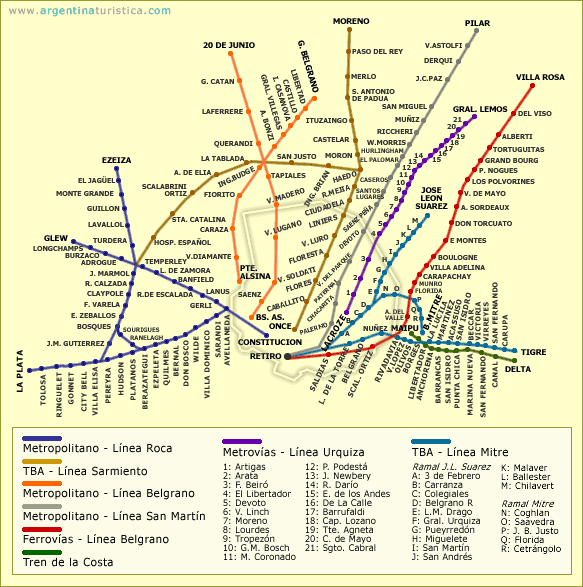
  • The Train (aka - El Tren) - The train is best used when going longer distances in and around the city. The cost is roughly the same, $1.10 - $1.35 pesos per ride, and it's best to buy your return ticket at the departing station, there is no assurance that the ticket windows will be open at the smaller stations that you're traveling to. The trains leave much less frequently than other forms of transportation and you need to be a bit cautious about which lines you ride. This map shows all of the city's train stops, but you want to do a little research before you just hop on. The Linea Mitre (light blue on the map) and Tren de la Costa (in green) are the only two lines that it has been recommended that we ride. Many of the other lines go through a large shantytown (with approx 1 million inhabitants) and there is a significant amount of crime on and around the train stations there. That is not to deter you though, as with most large cities you travel to, there are regions to steer clear of. We have used the Linea Mitre many times, to go to Tigre, to visit friends in the northern suburbs of the city and to take a more scenic route to areas north of us within the city. I feel comfortable riding this train alone, but only during daylight hours. The starting train station for this line is Retiro Station, and though the station itself is fine, don't wander the areas around the station, there is a shanty town that starts pretty close behind the station building.
  • Taxis (aka - Taxis) - This is the easiest, but most expensive public transportation option. We feel comfortable hailing a taxi off of the street, just use discretion before getting into a car. If the driver or the car look especially dirty or unkempt, or if you get a bad feeling from a driver, let the car go by and hail the next one. Generally, taxi drivers do not speak English so you want to know where you're going (in Spanish) or have the streets or address written down when you get into the car. We typically look at the general route before getting into a cab, just to make sure the driver is headed in the right direction. If you feel like they're running up your fare, or taking a roundabout route, you can certainly call them out on it. Also, by law, all taxis are non-smoking but some drivers have a tendency to forget this. It is your right to ask them to stop if they're smoking, but I have yet to exercise this right. It doesn't happen all that often, and if I get into a really smoky car, I can always just get out. Currently (as of 4/8/2010) the taxi fares are $4.60 to start and $0.46 per 1/8 mile (approx). A 10-15 minute ride will cost you between $15 - $20 pesos (~US$4.00 - $6.00) depending on the distance, and all taxis use meters. In general, drivers to not expect a tip, if you choose to leave a tip you can just round up to the next peso to leave the change. Radio Taxis are regarded as the safest, most reliable cabs out there, but we have only had one issue here (written about in my Concert post) and we've use a LOT of taxis. If you are using a taxi, be sure to have small bills. Taxis have been known to not have change for a $100 note and that leaves you in a very uncomfortable situation.
**Update 4/15/10- We have now had a couple of run-ins with dishonest taxi drivers. The general scheme is that the meters in these taxis run faster than in normal, honest cars. This was especially obvious when we took 2 cabs from the local airport and one ride was double the cost of the other. Grrrrr.
  • Private Cars (aka - Remis) - Many people hire unmarked, private cars for getting around the city. In general, we only use a Remis if we need to go to the airport, or a longer distance outside of the city where a taxi would be impractical. There are plenty of Remis companies, we tend to use Universal Remis, the company that Jon's work recommends. To use a remis, you call ahead and reserve a car for a specific date and time (this can be done same day if necessary). You can also reserve a specific sized car, which we do for trips to the airport. This is by far the most expensive option, but the most reliable. The round trip fee from our place to the international airport (EZE) with waiting time is approx $270 pesos (US $65) plus tip if they assist with luggage.
A great resource that was recommended to me is this website that allows you to input your starting and ending destinations and the site recommends the buses and subways that best fit your route. You can also specify the type of transportation you prefer. All in all, we have not missed our cars much. I have logged a LOT of miles on my feet too, since there are so many places within walking distance.

Saturday, January 30, 2010

Tigre

Tigre is an area approximately 17 miles north of Buenos Aires located on the Parana Delta. According to my guidebook, it is a "great jumping off point for river trips into the delta, comprising of 6,500 miles of canals, rivers and marshes". We have not explored the 6,500 miles yet, but it is a great place to go to get away from the bustling of the city. People flock to Tigre on the weekends with picnic lunches and Mate (ma-TAY, the tea that is a national obsession here) or you can take boat tours of the delta lasting anywhere from 45 minutes to 8 hours. There are restaurants and cafes lining the shore and both the Tren de la Costa and the local commuter train stop right next to the dock.


I have been there twice now, the first time was an experiment with my friend La
uren who came to Argentina to travel for a few months. We took the commuter train which is by far the cheapest way to get there ($2.70 pesos round trip), albeit a much longer trip. A side note about the commuter train, I don't mind the it, but I have heard some horror stories regarding safety (similar to any stories that you hear about trains in large cities) and you have to be willing to put up with people begging for money/trying to sell you things. As Jon pointed out, it's similar to a train in Europe where people do the same thing. Back to my trip with Lauren, the only information that we had was a short paragraph in her guidebook, so we were relying on our instincts to make it through the day. We easily found the boat dock and decided to follow her guidebook's advice and chose the boat taxi instead of going on a tour. What we didn't realize was that it was literally a taxi boat, more intended for the locals who live in the delta and need to come to town to grocery shop, etc. This is a cool concept for people living or renting houses on the delta because they must take a boat to get back to town, it's like living on an island. For us, this meant that the boat stop 150 times by the time we wanted to get off. We stopped at an area called "Tres Bocas" where we were told there would be shopping and restaurants. We found 2 restaurants that were completely deserted and absolutely ZERO shops. What the guidebook did not mention was that the delta is a perfect breeding ground for mosquitoes, and they were feasting on us. So we tried to leave Tres Bocas after about 20 minutes of walking around and could not figure out how to get back on the taxi boat. Three taxis passed us by as we waited...and with my limited knowledge of Spanish, I had no idea why they wouldn't let us on. We found some local folks that looked to be waiting to get back to the town and I asked them if we were waiting in the right spot. (I imagine that I sounded a little like this, "We want boat. We need boat for Tigre. You need boat for Tigre too?" Thank goodness for patient locals.) We made it back to town and had a great lunch that included a pitcher of delicious sangria. We had a great (though mildly hilarious) day.

For my guided trip, our friend Juan drove Jon and I to town and promised to show us the best places to go for shopping and eating in Tigre. It was raining a little so we stopped for lunch as
soon as we arrived. We went to this great place called Maria del Lujan that had a great menu with lots of choices from steak to Italian to sandwiches. We each got some sort of pasta dish, I got the tri-colored ravioli with Roquefort sauce, it was delicious. Afterward, we went to Puerto de Frutos, the port in Tigre. This area has a zillion places to buy furniture, art, clothing, crafts, home decor, etc. Intermixed with the crafts are fresh fruit and flower stands, complete with lots of potted herb plants. The style all was pretty similar, handmade wood and iron rustic looking items, just my taste. I could have spent all day here. Jon and I found this great painting that is now hanging in our front hallway (pictured below), and I plan to return sometime soon (I think Jon will be happy to pass on a second shopping trip) for a few other pieces that we saw.