Other Pages of Interest

Showing posts with label Services. Show all posts

Thursday, July 14, 2011

Vacunatorio

This past Monday we had Gretchen's 4-month doctor's appointment (albeit a bit late considering she is a few weeks over four months) and she is progressing just fine.  She is now at 6.8 kilos (15 pounds) and 63 cm (24.8 inches) our little grower keeps packing on the pounds, which is exactly what we want her to do.

And here are a couple of the pictures I took on her actual 4-month birthday.  The first photo was taken just seconds before the entire outfit (minus the socks) was covered in spit-up.  Second photo was just too precious to leave out.  Notice the socks were spared.


Although I was excited to see how Gretchen was progressing, I was also dreading this checkup because it meant that she was due for another round of vaccines.  I am a complete pansy when it comes to shots of any sort, and although it has gotten better since I've gotten older, I still needed my college roommate to hold my hand when I got my flu shot every year at school (thanks again Jules!), and it's just as difficult to see my little baby get shots.  Jon and I are of the mindset that since we are technically living in a third-world country and taking our baby on long distance flights multiple times in her first year, we'll go ahead and trust the AAP recommended vaccine schedule.  Honestly, we would have done so anyways, but these reasons just seal the deal.

Since the last round of vaccines that Gretchen went through at 2 months, we have had a change (for the better) in our medical coverage.  We are now covered by local insurance, which makes my life overwhelmingly easier considering that I don't have to submit receipts to our insurance company back home.  But, as with any change, I was a little nervous about the new process, especially when it comes to vaccines.

The biggest difference between what I'm used to in the US and here is that vaccines are not commonly given in doctor's offices.  We actually chose our pediatrician because he administers vaccines himself in the office (and, obviously, we liked his way of practicing medicine, etc, etc).   Also, if we have the doctor administer the vaccines, we have to pay in full, in cash and then wait for an 80% reimbursement from the US insurance company.  We went through that procedure back in April and the vaccines ended up costing us close to US$75 after the reimbursement.  Compare that to this week, when the shots were free.  And no paperwork.  Sign me up.

So, after our appointment on Monday, Gretchen and I took a decently long walk to the Vacunatorio.  There are quite a few locations in the city, our doctor recommended Stamboulian (Barrio Norte, 4515-3000; Pacheco de Melo 2941) and it was as good as a place that gives shots can be.  Clean, short lines and friendly staff. And I'm no hypocrite, I got my flu shot at the same time so I can vouch firsthand for how gentle they were.  For the record, Gretchen was an absolute trooper, she barely cried and just needed some extra loving and cuddles that night.  All in all it was a fine experience and it was made even better by the $0.00 bill we received at the end of our visit.  Not only that, they gave us a voucher for free parking (if we had driven).  Instead, we dodged pile after pile of dog poop on Pacheco de Melo (seriously, it must be a common dog walker route or something, it was intense) and walked home on a beautiful 60 degree night in the dead of winter here.  See you in 2 months, Vacunatorio, for the next round of vaccines! 

Sunday, July 10, 2011

Grand Cru

We have passed by the Grand Cru wine shop almost every day since we've moved to Buenos Aires, and though we've talked about going in to see if they offer tastings, we've never actually gone inside.  I am pretty sure the doorman actually recognizes Jon and I due to the number of times that we've walked by, so when we finally went to a tasting this past weekend we both felt that it was past due.  The tasting was the most well rounded we've attended in Buenos Aires, more professional that the Anuva tasting and less expensive than the Park Hyatt.

Grand Cru (Rodriguez Peña 1886: 4816-3975)We booked the tasting for Saturday afternoon from 4:00 - 6:00pm and were told to be prompt.  The tasting room was quite nice and deceivingly large considering the storefront view from the street. The atmosphere was nice, the chairs were comfortable, the table was made of wine delivery crates, it was a really cool spot.  We chose the Malbec tasting where they served four bottles of wine, each from a different Argentine winery and from different price points.  Here are the varieties we tried:
  • Pulenta - 2009 Gran Malbec
  • Doña Paula - 2007 Selection de Bodega
  • Catena Zapata - 2005 Malbec Argentino
  • Don Miguel Gascon - 2006 Don
We started by tasting each wine and discussing it with the sommelier, Ezekial.  After we tasted the four, we each discussed our favorites and Ezekial divulged the cost of each bottle.  We were then able to sit and leisurely finish the bottles of wine while they brought out a plate of cheeses and raisins.  You may notice the Nespresso machine in the background of the photo to the left, none of us requested coffee, but I'm assuming they would have been happy to serve us coffee after the tasting.

It wasn't an inexpensive evening, the tasting was $1800 pesos total, regardless of the number of people in the tasting.  In addition to the tasting room, Grand Cru has a fantastic selection of wines in their store.  There were a few very specific requests that our group had for certain bottles of wine (not necessarily all Argentine wines) and the shop had all of them.

It was a really fun, nice evening and we had a great time.  I would recommend the Grand Cru tasting as a nice thing to do with guests or a great evening with friends. 

Wednesday, February 2, 2011

Nail Salons: Part 2

As I continue my quest for the perfect nail salon, I have a few more contenders to add to the mix. As you may remember from my original Nail Salon post, I am searching for a good, clean, affordable pedicure place in Buenos Aires, and though there are a zillion salons to choose from I have found this to be tricky criteria to fulfill. Here are my most recently visited spots:

Fancy Fingers & Ladygardens
Located in a private residence in Barrio Norte on Parana. House visits also available, with the additional cost of transportation.
15-1300-8565, but email contact is preferred.
A friend originally recommended Sarah, the creator of Fancy Fingers & Ladygardens, as a good waxing person in the city. I visited her website and realized that she had much more to offer than just an eyebrow wax. Sarah and company offer nail services waxing and massages all for incredibly reasonable prices. She operates out of her apartment, which would be strange if she wasn't so incredibly nice and easy to talk to. I highly recommend her for waxing services as well, she has the cleanest room and supplies that I've seen in the city. With regard to her nail services, she gave a seriously thorough pedicure. She used a portable soaking tub (She used water! Hooray!) and unlike every other place I've gone that has used water, she used hot water and actually plugged the tub in for some foot-sauna action (every other place has used a similar tub, but cut the power cord off, thus, never plugging it in). The absolute best part of the whole experience was that she gave a great massage both during the pedicure and manicure. The massage is included in the cost of the service too, so you don't have to specifically request it or anything - music to my ears. Sarah had a pretty large variety of colors to choose from, although she readily admits that she wishes she had more O.P.I. brand, but they are ridiculously expensive here. This enjoyable morning of pampering was augmented by her pet turtle that wandered around the apartment while I was there - I thought this was adorable. Sarah is my new favorite, you feel like you've known her for years after 10 minutes or so, and I've already recommended her to my friends.
Products: B+ for color selection, A+ for cleanliness
Services: A
Facility: B+, it's just a tiny bit strange to be in someone's home for spa services.
Price: $100 pesos for a manicure/pedicure combo - excellent!

Estila Recoleta
Av. Pueyrredon 2436
4803-9047
This small hair salon actually offers a nice manicure/pedicure combination. I walked in without an appointment and was helped immediately. I sat on a 1960s-style white pleather couch for both services and it was one of the more comfortable seating arrangements that I have come across. They used a water foot bath, clipped and scrubbed and the whole nine yards. They had a pretty limited selection of colors, but the colors I choose lasted for a really long time without chipping. There was no massage, which is pretty normal here but now that I've had one included in the service I feel like I was shorted. I like Estila Recoleta, they were clean and prompt and friendly. My only complaint was that it was really hot in the salon to the point where I requested that the AC be turned on. Why the AC wasn't on already on a hot summer day is beyond me. Also, there are two types of pedicures to choose from, if you want more than just a paint-job, you need to specify at the door that you want a "pedicuria".
Products: C
Services: B
Facility: B+
Price: $98 pesos for a manicure/pedicure combo

Branka
Av. del Libertador 902
4812-0462
I won't spend too much time on this review because this was by far the worst pedicure I've ever had. Disappointing too because this is the closest salon to my house, but it was really dismal. I walked in without an appointment, and although they were not busy and took me back right away, the woman mentioned multiple times that I really should have called first. I sat in a standard haircut chair while the technician sat across from me in a cafeteria-style plastic seat. She used a foot bath tub, but then had me prop my feet up on her knees which immediately soaked through with water. Not to mention that I've got a huge baby belly and have a hard time lifting my feet up to her knee level. It was incredibly uncomfortable, and then she cut me to the point of bleeding in at least 3 spots. Gross. I will not be back, with or without an appointment.
Products: C
Services: F
Facility: C
Price: $120 pesos for a pedicure. Most expensive pedicure I've had in BsAs.

I stand by my previous recommendation of The Nail Company and will add Estila Recoleta to the recommendation list. If you have time to make an appointment, definitely call Sarah at Fancy Fingers, she is really worth the forethought.

Wednesday, January 19, 2011

Pregnancy Abroad

Back in my first post about pregnancy (Dawn + Jon = Baby Girl) I mentioned that there would be more posts about medical care and pregnancy abroad. If you are interested in that sort of information, this post is for you!  I will preface the entire post by saying that all of this information is specific to my experience, I don't presume to know anything about healthcare or pregnancy abroad that is outside of my personal experience. 

I am now over 7 months pregnant, and things seem to be progressing quite normally.  I wish it was a bit cooler outside, but aside from that, I really can't complain.  For those of you who are interested in hearing some of the differences in pregnancy care here in Argentina, or those that are in Argentina and need advice on prenatal care, here is my best attempt to capture the differences. 

Doctor
I see Dr. Juan Procaccini who is located in Palermo and I think the world of him.  He speaks fluent English and is extremely patient with our questions/concerns/confusions.  If you would like his contact information, please email me, I am happy to recommend. 

Pros: 
  • I have never waited more than a day for an appointment, including my first "new patient" appointment in which he saw me 2 hours after I called.  
  • He gave me his cell number the first time I saw him and I am able to call at any time with questions.
  • He is the only doctor in the practice, so I know who will be delivering our baby.  
Cons:
  • All lab work is done in other locations, so each time I have blood drawn or need an additional test I need to go elsewhere.
  • The nurses/other professionals that he works with do not speak English.
  • He is the only doctor in the practice, so if he has an emergency to tend to or is running late, the whole office/all appointments are dependent on his schedule.  
  • All office visits are paid in cash.  It's a little strange.
Prenatal Care
The prenatal care the I have received is similar to that of many other pregnant mothers that I know, surprisingly, I know quite a few pregnant ladies here.  It is, however, different than that of friends of mine in the US.

Pros: 
  • More frequent appointments.  I started with appointments every 2 weeks in my first trimester, graduated to every 4 weeks in my second & went to every 3 weeks starting my third.  At 35 weeks I'll go on a weekly basis until delivery.  
  • More frequent ultrasounds. I have have an ultrasound at every appointment, and by the end of my pregnancy I will have had four 3D ultrasounds.  
  • Cost.  We are considered "out of network" for all of our medical care so we pay everything in full and then submit it for reimbursement.  Considering that we pay in full, before insurance, the cost of medical care is incredibly low compared to what we are accustomed to in the US.
Cons:
  • There is a huge emphasis on low weight gain during pregnancy.  The recommendation is to gain 15 - 20 pounds total versus 25 - 35 pounds recommended in the US. As if I wasn't already feeling fat, I get to go to a zillion appointments that tell me how much weight I've gained.
  • Confusion. There are so many recommendations in the US that are not necessarily followed here that I find myself a bit confused at times.  Food and drinks to stay away from, exercise requirements, travel limitations and other recommendations are completely different.  This is why it is extremely important to have a doctor you trust, they can help you sort out all of this conflicting information. 
  • The childbirth classes with our midwife are in Spanish.  We are doing pretty well with them, but it still makes life a little more difficult.  
Hospital
I have visited our hospital (Sanitario de la Trinidad) and am very pleased with the facility and the level of care available. If you are delivering in Buenos Aires, contact your hospital about taking a tour, there are not always organized tours available but I have found that they will show you around if you ask.  There are some differences, not necessarily pros/cons, that I thought would be fun to mention. 
  • Some of the hospital services include; delivered meals, daily paper and wi-fi (things that I would expect) ear piercing for girls, baby haircuts and baby cologne (things that surprised me).  
  • You need a reservation.  Considering I have no idea when baby girl is going to be joining us this might a bit difficult.  
  • There are strict visiting hours (for our hospital 8 - 12p & 4 - 8p) where only 1 person will be allowed in the room outside of those hours.  Bummer for close family/grandparents/etc that would like to help out in the other hours of the day.  
There is a whole other world of childcare that we will discover after the baby is born.  Things like car seats (not required here), grocery shopping (no child seats in the front of the carts), breastfeeding (totally acceptable in public, with or without cover) and all sorts of other adventures lie ahead.  I have found resources in BAExpats.org, BAIN and other bloggers in Argentina, but if you are in Buenos Aires and are interested in talking pregnancy shop - let me know!

Friday, November 19, 2010

Nail Salons

FYI - this is going to be a total girl-centric post. You've been warned.

I'm a sucker for some girly pampering; nails, massages, facials, etc, I enjoy them all. These types of services I assumed would be exactly the same, only cheaper here, and I was 50% right. As far as nails are concerned, they are generally cheaper. The biggest difference is the was pedicures are done (sometimes without water!) and the range of services available depending on the salon. It's been interesting trying to find any sort of information on nail salons in the area, there really isn't much out there to be seen.

I have only tried a couple of places, but here are my thoughts on the few places I've been:

The Nail Company
Riobamba 1164
4815-2139
I really like this place - it's clean, the people are nice and the prices are right. There are two locations, I've only been to the Barrio Norte location, but it's the best all around experience out of the salons I've been to. So far as I can tell there are no walk-in appointments, so be sure to call first. There are several different types of manicure and pedicure services ranging from basic to paraffin dip to the "super perfect" which includes paraffin, exfoliation and a massage. The facility is quite nice, but they are missing the great massage chairs with an attached foot bath like they have in the US. Instead you get a plastic portable foot tub (like the one every mother has received for Mother's Day at some point), but it serves it's function just fine. They also use all of their own products, which are nice, but I still prefer the O.P.I. brand polish since there are so many additional color choices in their line.
Products: B+
Services: A
Facility: A

Nail Designers
Juncal 1615
4813-1892
Nail Designers was recommended to me by a friend, and they gave a good pedicure, with one strange twist. They didn't use any water. I sat in an extremely nice recliner and put oil soaked cotton on different parts of my feet and then used a scalpel to scrape away callouses. Not the potato peeler thing that I'm used to, an actual surgeon-style scalpel. I was petrified. Imagine a full on scalpel on completely dry skin. Scary. That and there was no massage included with the pedicure, even though I requested a massage ahead of time. They had a number of colors choices, and their products were of good quality. The price was right, 60 pesos (US$15), but without water or a massage, I have not returned.
Products: B
Services: B
Facility: B+

Yin Yang Pie
Arenales 2189
4824-2011
This hilarious named salon is really great for massages, but the pedicures leave some things to be desired. Like Nail Designers, they are also on the list of salons that don't use water, and that just generally freaks me out. In addition, the chair was not all that comfortable. They did use great products and when I asked for a massage to be included with the pedicure they gave me a 30 minute, lay-down foot and leg massage that was amazing. I will be back for the massage, I'll stick with another salon for the pedicure.
Products: A
Services: Pedicure: C / Massage: A+
Facility: B

Hairmony
Av. Quintana 432
4808-0308
This place is actually more of a hair salon that offers nail services, and the services they offer are decent. The pedicure was basic, no frills or massages, but there was water involved so I was a happy girl. The real downside of this place was their products, the basket of polish that they gave me to look through could have come from a little girl's dress up collection.
Products: D
Services: Pedicure: C+
Facility: B

There are a zillion places to choose from in the city and I'll probably keep trying until I find the perfect pedicure. For now, I'll stick with The Nail Company for my manicure and pedicure needs.

Thursday, September 2, 2010

Tintoreria

Bad news, our washing machine broke. 

Not really bad broken, but tiny-plastic-piece-that-is-really-important-to-the-functioning-of-the-machine broken.  The piece that broke keeps the door latch in place, and the fact that we have a front-load machine, latching the door is really important to the functioning of the machine. 

Even worse news, according to our building manager this teeny-tiny repair may take up to 4 months to complete.  That's right, apparently the Whirpool representative is swimming the new part here to fix the machine.  Let's all hope he swims quickly.

In the meantime, we get to explore the option of a tinoreria, Spanish for laundromat.  I had my first outsourcing laundry experience this week and it was pretty painless.
Our closest laundromat is only a block away, so that was nice and easy.  We were hoping for the best when the washer first broke so we waited a little too long before taking our clothes in, three enormous bags of clothes are heavy.  Our three bags translated into 4 "loads", each load costing $17pesos (~US$4.25).  The wash was done in less than 24 hours and it came bagged and folded - so all in all an OK deal.  The worst part of the whole experience was that today was the rainiest day EVER so I had to carry four bags of laundry across a flooded street while balancing an umbrella in the wind.  Not Fun.  The good news for next time, when I picked our clothes up today the nice laundromat woman mentioned their delivery service.  I wish I knew how to say "information more useful to me yesterday" in Spanish. 

Pros of Not Doing Laundry:
  • Not doing laundry
  • Our clothes came back folded and clean
  • I don't know what they use, but the clothes smell really good
Cons of Not Having a Washing Machine:
  • Unnecessary extra spending
  • It's weird toting dirty laundry down a busy city street
  • Now we have to plan in advance if we want to wear something, instead of throwing a load in when I needed some clean jeans
We're hoping for the best when it comes to fixing our washer, I imagine that the novelty of not doing laundry at home will quickly wear off.

Thursday, July 22, 2010

The Need for Change

There are a countless number of cultural differences that take getting used to in a new country.  Argentina is no exception. 

Some differences take one or two instances of exposure before growing accustomed.  Little things like remembering to ring a bell and get buzzed in to enter stores during business hours (due to heightened security) or to avoid shopping in the middle of the day when many shops inexplicably close for a few hours. 

Some take months of exposure before becoming habit.  Things like kissing on the right cheek when greeting hello and goodbye to people - even during first meetings, or remembering to keep my keys in hand while leaving our Alcatraz-style apartment so that I can unlock the three separate doors on my way outside. 

And then there differences, the one in particular that inspires this post, that are easy to remember, but incredibly difficult to understand. 

Change.  Literally, coins or monedas.  There is a perpetual drought in Buenos Aires in the form of small bills and change.  It is some sort of bizarre phenomena that I cannot for the life of me figure out.  This extreme culture difference is exacerbated by the fact that coins are something that I've spent all my adult life in the US trying to get rid of.  There are literally trays of free pennies for those who just want to give away their change.  Not only that, but who uses cash anymore??  Aren't we a plastic-using society?  Not here, not in Bs.As.  All cash, (almost) all the time, and don't even try to pay with your $100 peso note because you can be sure that they don't have change.

We have managed this money drought a few different ways.  First hurdle: Breaking large bills.  Whenever we withdraw money from the ATM, we always attempt to withdraw in odd numbers, the best being a number that ends in $90.  This plan is foiled by the ATMs that only carry $100s and $50s.  Keep in mind that a $100 peso bill is roughly the equivalent to US$25, so it's not like we're toting Benjamins all over town.  Another way is to pay with a $100 at any store that will accept it, more likely at larger grocery stores or upscale shops.  We then stockpile the smaller bills in our safe for later use.  It has become my part-time job to ensure that we have small bills in our safe at all times.  It sounds silly, but it's a very real part of everyday life to make sure that you always have small bills in your wallet.  The lack of can lead to very uncomfortable situations. 
Exhibit A) I was riding in a cab with $212 pesos in my wallet (with two $100s), we arrived at my destination and fare was $18 pesos.  The cabbie couldn't break my hundred and I had no other money.  I had to short him $6 pesos for the ride, and clearly no tip.  Awkward. 
Exhibit B)  I was shopping at a small bulk health food store where the shopkeeper needs to portion out and weigh all of the items.  After putting together 7 or 8 items, I went to the register with my $100 and they couldn't break it.  And they didn't take credit cards.  And I left the store empty handed - 45 minutes of my life I'll never get back.


So many bus rides!
Second hurdle:  Coins.  Coins are the only form of currency for those that use buses, and since Jon uses the bus to commute, and I use it when I know where I'm going, we go through a lot of change.  People go to great lengths here to avoid giving you change.  Some small shops will give you candy instead of change when your bill is uneven.  Cashiers will ask you for change to round up your bill so they can supply your change in all paper.  Taxi drivers will round your fare down to avoid giving you coin change.  It's incredible.  So, how do you accumulate change?  The method of choice for me, up until yesterday, was to go to the bank.  I would travel to the bank, a couple times a week, stand in line like a dunce for 15-45 minutes and receive a grand total of $10 pesos worth of change.  That's right.  Even the BANK is stingy with coins.  Yesterday, I discovered the mecca of all change locations:  Retiro Station.  Retiro train station has a designated window for monedas because it is a huge bus hub and their train ticket machines only accept coins.  This window inevitably has a 100 person line, but I happen to be at the train station yesterday and it was worth it to save a trip to the bank.  I was even going to kill two birds with one stone and pay for my pesos with a $100 bill, so I could get small bills AND coins.  Imagine my surprise when I get to the window and the man behind the counter gives me $50 coins.  FIFTY.  Five saved trips to the bank.  I couldn't believe it.  And then, I couldn't believe how happy I was to receive coins.  Times have certainly changed.

Our coin reserve is plush now, although it certainly won't last forever.  Note to those in the Bs.As. area that need coins, Retiro is the place to go.  Anyone with other change and small bill tips, please feel free to share.  This is one battle that I had never envisioned myself fighting.   

Wednesday, May 12, 2010

Amazon Kindle

My husband, along with virtually his entire family, loves and - more importantly - understands electronics. This is perfect for me because I enjoy having things that make life easier but I have no idea what is out there, much less where to buy it or how to set it up. This is also great for me because it means that I tend to receive amazing, technologically advanced gifts that I never even knew existed. I am quite spoiled in this regard. Although there are quite a few things that I could put in that category (my iPod, laptop and cell phone to name a few...) I need to shed light on one item in particular because I think that expats are really missing out on this delightful piece of technology. The Amazon Kindle.

My 1st generation Kindle
My Kindle was a Christmas gift from my in-laws in 2008 when I was still commuting to work on the train everyday. The Kindle is a product of Amazon (there are others out there by Sony and other companies) that wirelessly downloads books, magazines and newpapers from anywhere in the US in under 60 seconds. The newer versions of the Kindle offer 3G global coverage, making it even more appealing to expats the coverage is good in over 100 countries, and holds a longer charge (up to 1 week of reading on one full charge) than the previous models. This is especially good for those multi-day flights or for the backpacker who won't be near a power source for days on end. There are literally hundreds of thousands of titles to choose from with more titles being added every day. The Kindle also has the ability to connect to your computer using a USB cable for people like me who have the older version and live outside of the country. The device itself is lightweight and easy to use - especially easy on the eyes. The screen reminds me of an Etch-a-Sketch, that matte finish screen that makes the text really easy to read. Oh Kindle, here are the reasons I love thee:
  1. For my former commute, I didn't have to carry an enormous book with me on the train.
  2. It is small enough to keep in my purse all the time for things like waiting at the doctor's office, taking a lunch break or sitting at a cafe.
  3. Before we moved to Buenos Aires, we lived in a relatively small apartment where we barely had enough space for our own things, much less the space to store all of the book that I read.
  4. Now that we live in Bs. As. it is hard to find English bookstores that carry the titles I want. Not an issue when you have a Kindle.
  5. When I'm out of the loop with regard to current good books, I can go onto the New York Times bestseller list straight from the Kindle. Not only that - but you can download a "sample" of a book before you buy it for no cost!
The downside of the Kindle is that it's not cheap. You pay one price for the device (unless you get it as a gift - thank you Thom and Lornie!) and then pay separately for each book that you download. The book prices vary, but the most expensive I've seen is $9.99 for a new release hardback NYTimes bestseller. Not too bad if you consider that most of those books on the shelf are < $20.00 when they first come out. I have been stopped on the street, on the train and by people in stores to ask if I like the Kindle and my answer is always an overwhelming YES. If you are thinking about getting one for yourself or as a gift for someone else don't think twice. They will love it.

Tuesday, April 27, 2010

Anuva Wine Tasting

We've been looking for interesting things to do with people while they visit, preferably involving food and wine. I've heard about a few people that run services out of their homes, cooking classes, dinners, but we had never booked anything until I heard of a local wine tasting put on by Anuva Wines. Anuva is an interesting concept, Daniel Karlin started a company that finds great wines on their own and then sells them to private buyers through a wine club, private tastings and home shipping. The US$40.00 tasting included all things that I find interesting, 5 wines, 5 food pairings and a chance to meet some new people in Bs.As., so I signed the four of us (Jon's parents, me and Jon) up for a Wednesday evening tasting.

Anuva Wines is located near/in the Las Canitas neighborhood of Palermo, so we immediately decided to go to Morelia afterward. We were at least 20 minutes late to our tasting reservation due to the crazy rush hour traffic when we arrived at a nondescript apartment building and pushed the appropriate buzzer. This was my moment of panic - Did I really just bring my in-laws to a stranger's apartment in a foreign country? I sure did. So I started the "If-it's-not-good-at-least-it-was-an-adventure" excuses. Luckily, we were greeted by a nice young lady that escorted us to the tasting apartment and she quickly put my mind at ease. When we arrived at the apartment, the table was set with 5 food bites that paired with our wines and 3 other people that had arrived on time to the tasting. We dove right in to the first tasting, a unique sparkling white called Hom (pictured), paired with 2 fresh sorbets served in adorable little shot glasses. I was loving the Hom, enough to buy a bottle at the end of the tasting. The wines were quite good (with the exception of one Malbec that I personally didn't like) and the food pairings were spot on to the point of impressive. We left with 4 bottles of take home wine and a case ordered for delivery to Jon's parents when they arrived back in Virginia (that's right, they ship to the States!). Daniel is extremely knowledgeable about wines and does a good job of explaining the wines as you're tasting them. It was a unique and fun night - and I recommend booking your own wine tasting or placing an order. We enjoyed our evening and are still contemplating joining the Anuva Wine Club where you can opt to receive up to 48 bottles per year.

Now for my two cents. Not that I'm any expert, but my years in the restaurant industry have made me cynical of these types of events. I have two recommendations for improvement:
1) Slow it down. It was a relatively rushed presentation that could have allowed for more conversation about the wines and between the customers that didn't. If we diverted from discussion about the wine, Daniel quickly brought us back to the task at hand. I think that slowing down the presentation would help the patrons feel more comfortable and help with the wine sales.
2) Keep everyone on the same level. As wine tasters we were all sitting around a table, tasting the food and wine while our presenter stood above us walking around the table. This gave the tasting a teacher/student feel, which would be better off played as a peer/peer feel. Sit down. Have a glass of wine. It would create a more comfortable and relaxing environment, holding true to the company's theme.

All in all, a great night with delicious food and wine. We enjoyed meeting the other people at the tasting, Daniel was a gracious host and we have a fun, unique evening under our belts. We found out that Daniel will do in-home events, so we're thinking that this may be our next party to host.

Thursday, April 15, 2010

Aeroparque Jorge Newbery

Also known as the "other" Buenos Aires airport, Aeroparque Jorge Newbery (airport code: AEP) is the source of most of the domestic flights in Argentina. This airport also offers flights to Argentina's South American neighbors like Brazil, Paraguay, Uruguay, Chili and Peru. We first discovered Jorge Newbery when I was booking my flight from the US to Buenos Aires and my heart momentarily stopped when I realized that there were two airports in Bs. As. and I had no idea which one I was supposed to book. This proved to be an unnecessary panic attack. Jorge Newbery does not have any direct flights from the US, and we always use the amazing United Airlines direct overnight flight from Washington, Dulles to Buenos Aires, Ezeiza Airport. Therefore, if we are flying without a connection, we're not flying to Jorge Newbery.

Jorge Newbery is actually a much closer airport for us. Located in Palermo, this airport is only a 15 minute cab ride from our apartment versus Ezeiza, which is close to 22 miles away. It's even more convenient because we can hail a cab outside our apartment instead of hiring a Remis in advance, which involved much more organization and advanced notice. The two major airlines that work out of Jorge Newbery are Aerolineas Argentinas and LAN, both government owned. We have found that Aerolineas Argentinas has better flight times, prices and flight frequency so for the two domestic trips that we've booked so far (Bariloche and Iguazu Falls), this is the airline we've used. Apparently, we are not alone, the ticket lines for AA were packed this morning.

Today we are on our way to Iguazu and we have hit our first hiccup in the Aerolineas Argentinas system. A few weeks ago I received an email that our flight time had changed from 11:30am to 9:20am, and that our tickets were automatically confirmed for the earlier flight. Sounds great. Then we arrive at the airport at our earlier designated time only to find that the flight before ours was canceled leading to a domino effect that left us without seats on the 9:20am flight. We then were rebooked on a 1:30pm flight. Not a huge inconvenience for us, but we would have preferred to sleep in and have a leisurely morning versus spending a few extra hours getting to know Jorge Newbery better. The only redeeming factor was that we were given a "light snack" voucher to spend at the airport for our inconvenience. Wish us luck!

The guys are sad over our airport delay. Lornie doesn't seem to mind.

Tuesday, April 13, 2010

Brazilian Tourist Visas


We have been compiling a list of places to visit while living in Buenos Aires, and the destination that tops that this list is Iguazu Falls. Iguazu Falls are comprised of a strip of 250 falls over a 2 mile strip nestled between the northeastern tip of Argentina, Paraguay and Brazil. With Jon's parents visiting in April, after the major mosquito season is over, we planned a trip to Iguazu while they are in town. Through recommendations from our friends, we were told that the trip could be maximized by spending time on the Brazilian side of the Falls. As we soon learned, as Americans, we need to obtain a tourist visa to step foot in Brazil, even if it's only for a few hours. This is a direct result of America requiring Brazilians to obtain a visa before coming into the USA, including a fee that matches what the US charges - referred to as a "reciprocity fee". As of today, this fee is listed as $130 for a 90-day visa, yikes! We have been assured that this fee is worth it, I'll update you on whether we feel the same way after we return.

The interesting part of this process was the difference between the steps listed on the Brazil Embassy website versus the actual steps that we were required to take, so if you are in the market for a Brazilian visa - Beware! I read a number of blogs on the subject before we started the process, so we were ready to be surprised, but each person has a slightly different version of the process (us included). We spoke to a Canadian couple standing behind us in line for their visas and they had changed all of their reservations based on what they heard from friends, and in the end, this was an unnecessary inconvenience. So, here is how the process for an American obtaining a Brazilian tourist visa in Argentina panned out for us:
  • Fill out the online visa application form. Jon's parents were prepared enough to do this ahead of time, I filled out some other form that was expired so I filled the forms out when we got to the Brazilian Consulate. The goal is to have an application number, which is part of your form submission confirmation.
  • Go to the Brazilian Consulate building at - Carlos Pellegrini 1363 - Piso 5 from 9:00am to 1:00pm Monday - Friday. We went right at 9:00am and had approximately 6 people ahead of us. Bring with you:
  1. Your US passport that has at least 6 months left before it expires. You also need to have at least 2 empty pages in the back "visa" section.
  2. A 2x2 passport photo on white background. Neutral facial expression is best.
  3. Round trip travel information, they want to make sure that you're not going to stay in Brazil. We are not actually flying into Brazil, but our Iguazu, Argentina flight confirmation did the trick.
  4. Address and phone number of your hotel or overnight accommodations. Again, we are not staying in Brazil, but this was of no issue.
  5. A bank statement with the name of the account holder that proves you have at least US$1,000 in the bank.  The statement must be from the last 90 days, preferably printed that morning.  
  6. Tourist visa application number, if you were smart enough to get this in advance. If not (like me) you are able to get a number on the computers at the consulate, but they are s.l.o.w.
**Note: Some information we read stated that you need proof of a recent yellow fever vaccination,  proof of work in Argentina and various other documents. We did not need any of these items.
  • Bring this information up to the teller window. The teller fills out a paper, asks you a few questions, and has you sign your name on the paper (so each person requesting a visa must be present). This is the part where she takes your passport and photo (and I have a mild heart attack thinking that something will happen and she won't return them).
  • You will get a deposit slip with the address of a bank that you need to pay your reciprocity fee to. The teller told us to pay the fee and come back after 12:00pm the following day to receive our completed visas.
  • We went straight to the bank (approx 4 blocks away) and paid our fee. So far as I can tell, the bank will only accept Argentine pesos. The bank gives you a confirmation of payment slip - guard this with your life.
We returned to the Consulate the following day at noon to turn in our confirmation of payment and collect our passports with shiny new Brazilian visas inside, just like the teller said. We were also pleasantly surprised to find that the visas are good for 5 years, not the 90-days we were expecting. All in all, the process was not nearly as painful as I had expected, save a few extra errands. It was funny to see the same people in line at the Consulate, then the bank, then the Consulate again the following day. We head out to the Falls on Thursday, armed with our entry passes to Brazil!

UPDATE: The Brazilian Consulate has begun requiring appointments for all visa requests. This was only a mild issue for us, who did not have an appointment. The teller gave us a frustrated look and a sign when we told her that we did not have an appointment but she let us process our request that day regardless. I would recommend making an appointment, the next teller may not be so nice: Brazilian Tourist Visa appointment directions.

Thursday, April 8, 2010

Getting Around

Jon and I have never been the type of people that specifically wanted to live downtown in a city. We never even entertained the "what if" scenarios to know what would happen if we were ever to live in a city so when we decided to get an apartment in Capital Federal Buenos Aires, we had a lot of decisions to make. One of the easiest decisions we came to was that after we sold our cars in the US, we would not look to buy a car in Argentina. The only tough part of this decision was made for us, we had no choice but to sell our cars as we left Virginia. An ode to my car, I loved my beautiful 2007 Honda Accord, and I'd be willing to say that my love was shared by most people who rode in it. That car was the preferred ride to many a football game, with it's roomy 4-person seating area and satellite radio, and the trunk fit the absurd amount of luggage that we inevitably pack for every trip we took. I take comfort in knowing that she went to a good home.

Now that we are car-less, we have become reliant on the public transportation system to get around the city. Lucky for us, there are quite a few options and they are all pretty easy to navigate.
  • The Bus (aka - El Colectivo) - This is Jon's ride to and from work each day. It works like a charm and picks up directly in front of our building. The key to the buses is this little book called a Guia"T", don't leave home without it. The book has two sections, one with maps where you look up where you are and where you're going and see which buses overlap and a second part that lists all of the buses and their routes. The other tip is that if you're planning on taking the bus, be sure to have coin change in your pockets - the buses only take coins. The cost ranges from $1.10 - $1.25 pesos per trip.
  • The Subway (aka - El Subte) - There are six subway lines in the city, each line having it's own color and letter that you can clearly see from this little map. The lines are referred to by their letters, but having ridden the Metro for so long, it's hard for me to break the habit of referring to the lines by color. Each stop is very clearly marked from the street and a 1-trip ticket will cost you $1.10 pesos. The closest subway stop to us is about a 15 minute walk, so we tend to use other forms of transportation, but it is a really convenient way to get around the city quickly if you have a stop nearby. The trains themselves are pretty different depending on what line you're using, back in December we were touring around the city with Juan and Sole and we got on an antique A-line train where you have to open and close the doors yourself. A little nerve-wracking for me since people tend to open the doors before the train stops. Security is a bit of an issue here so you want to be extra careful in crowded places like the subway. I would also advise that you should not ride alone at night - just to be on the safe side.
Here are Jon, Juan and Sole going into the subte station. They're laughing at the number of photos I'm taking.
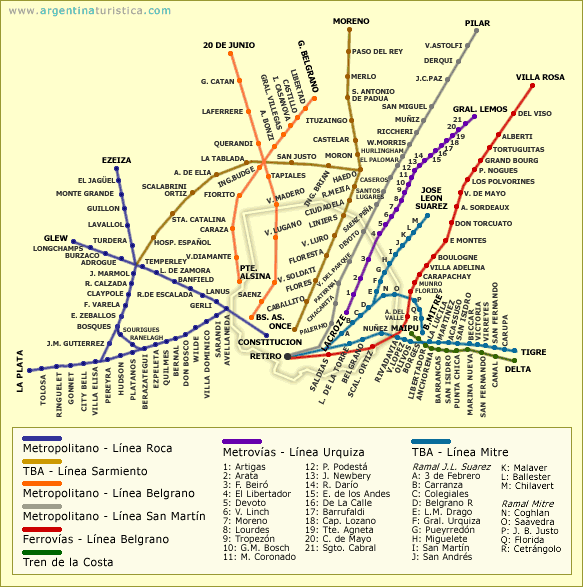
  • The Train (aka - El Tren) - The train is best used when going longer distances in and around the city. The cost is roughly the same, $1.10 - $1.35 pesos per ride, and it's best to buy your return ticket at the departing station, there is no assurance that the ticket windows will be open at the smaller stations that you're traveling to. The trains leave much less frequently than other forms of transportation and you need to be a bit cautious about which lines you ride. This map shows all of the city's train stops, but you want to do a little research before you just hop on. The Linea Mitre (light blue on the map) and Tren de la Costa (in green) are the only two lines that it has been recommended that we ride. Many of the other lines go through a large shantytown (with approx 1 million inhabitants) and there is a significant amount of crime on and around the train stations there. That is not to deter you though, as with most large cities you travel to, there are regions to steer clear of. We have used the Linea Mitre many times, to go to Tigre, to visit friends in the northern suburbs of the city and to take a more scenic route to areas north of us within the city. I feel comfortable riding this train alone, but only during daylight hours. The starting train station for this line is Retiro Station, and though the station itself is fine, don't wander the areas around the station, there is a shanty town that starts pretty close behind the station building.
  • Taxis (aka - Taxis) - This is the easiest, but most expensive public transportation option. We feel comfortable hailing a taxi off of the street, just use discretion before getting into a car. If the driver or the car look especially dirty or unkempt, or if you get a bad feeling from a driver, let the car go by and hail the next one. Generally, taxi drivers do not speak English so you want to know where you're going (in Spanish) or have the streets or address written down when you get into the car. We typically look at the general route before getting into a cab, just to make sure the driver is headed in the right direction. If you feel like they're running up your fare, or taking a roundabout route, you can certainly call them out on it. Also, by law, all taxis are non-smoking but some drivers have a tendency to forget this. It is your right to ask them to stop if they're smoking, but I have yet to exercise this right. It doesn't happen all that often, and if I get into a really smoky car, I can always just get out. Currently (as of 4/8/2010) the taxi fares are $4.60 to start and $0.46 per 1/8 mile (approx). A 10-15 minute ride will cost you between $15 - $20 pesos (~US$4.00 - $6.00) depending on the distance, and all taxis use meters. In general, drivers to not expect a tip, if you choose to leave a tip you can just round up to the next peso to leave the change. Radio Taxis are regarded as the safest, most reliable cabs out there, but we have only had one issue here (written about in my Concert post) and we've use a LOT of taxis. If you are using a taxi, be sure to have small bills. Taxis have been known to not have change for a $100 note and that leaves you in a very uncomfortable situation.
**Update 4/15/10- We have now had a couple of run-ins with dishonest taxi drivers. The general scheme is that the meters in these taxis run faster than in normal, honest cars. This was especially obvious when we took 2 cabs from the local airport and one ride was double the cost of the other. Grrrrr.
  • Private Cars (aka - Remis) - Many people hire unmarked, private cars for getting around the city. In general, we only use a Remis if we need to go to the airport, or a longer distance outside of the city where a taxi would be impractical. There are plenty of Remis companies, we tend to use Universal Remis, the company that Jon's work recommends. To use a remis, you call ahead and reserve a car for a specific date and time (this can be done same day if necessary). You can also reserve a specific sized car, which we do for trips to the airport. This is by far the most expensive option, but the most reliable. The round trip fee from our place to the international airport (EZE) with waiting time is approx $270 pesos (US $65) plus tip if they assist with luggage.
A great resource that was recommended to me is this website that allows you to input your starting and ending destinations and the site recommends the buses and subways that best fit your route. You can also specify the type of transportation you prefer. All in all, we have not missed our cars much. I have logged a LOT of miles on my feet too, since there are so many places within walking distance.

Tuesday, April 6, 2010

BAIN

Buenos Aires International Newcomers (BAIN) was recommended to me before we moved as a good way to connect with other expats in the area. The group takes anyone, newcomers or longtime Bs.As. residents, with the common thread that everyone speaks English. The larger group is divided into two sections of BAIN, suburbs and downtown, generally the suburbs group is more families and the downtown group is more couples without kids, singles and retired folks. I am involved in the downtown section.

BAIN is a great way to get involved in events, meet new people that are also looking to get involved and see areas of the city that you may otherwise have passed by. I spent my first month here reaching out to people on my own and exploring the city out of guidebooks and internet recommendations. Although I feel like I did a pretty decent job on my own, as soon as we returned from a two week vacation in the US, I had run out of ways to occupy myself. Nothing is more depressing than sitting at home with a silent phone, so I promptly joined BAIN. I met Bonnie, the downtown group president at a restaurant called Empire Thai, where she meets potential new members every Friday. My intention was to sign up, pay my $100peso yearly fee and then head back home, but Bonnie and I struck a great conversation and I ended up sharing a 2.5 hour lunch with her and one of the restaurant owners, Kevin.

BAIN offers monthly lunches and dinners at new restaurants, monthly meetings with guest speakers and a social network for buying and selling items when other expats move through the area. This is where I finally bought an artificial Christmas tree, something that I was trying to buy for a few months before I found a good price through the BAIN buyer/seller network.

For me, the most beneficial perk of BAIN are the English speaking tours in unique museums and cultural spots that they arrange each month. I've attended every tour that I was available for and without fail, they have all been excellent. The only tour that I have been able to write about so far was the Museo Evita but there are more to come. All in all, BAIN has been a great resource for me to network, see the city and exchange advice with folks that have been here and have lots of tips to share. Well worth the US$25 yearly fee.

Update: As of yesterday, I'm up to a long run of 6 miles! My legs feel like Jell-o and I'm hoping to be able to walk today, but I am successfully over halfway to the goal!

Friday, April 2, 2010

BASP

Anyone who has every moved knows that as soon as you tell your well-meaning friends where you are headed, inevitably, someone knows someone who has been there before, lived there once or has a [insert random-relative here] that talked about going there. This "do-you-know-_____" syndrome only multiplies when you are headed to another country. Don't get me wrong, we relished these connections. We are lucky enough to have had one of these connections actually pan out and we are now happy to say that Kelly, Tabo and their adorable little baby Enzo are great new friends of ours. Kelly has been a wealth of information for me, she knows Castellano, has lived here for quite a while and she's incredibly nice. Needless to say, we have become quick friends. One of her many amazing recommendations was BASP, the Buenos Aires Spanish School. (Side note: I have no idea where the "P" comes from, maybe Portuguese? I believe they have classes for that too.) I have been taking lots of private Castellano lessons, so at first I didn't see the benefit to going to an addition class. When my tutor decided to go on a short vacation, I seized the opportunity to take some additional classes.

The school is located in Plaza Congreso, which is literally in the heart of the city. To compare, it's like The Mall in DC. I have gotten comfortable with the bus system here, so I commuted each day by bus - making it really feel like school. BASP has a number of programs, but I decided to enroll in their 2-week long small group sessions, which run 4 hours per day, 5 days a week for US$280 (total for 2 weeks, $7 per hour - not too bad, right?). The correspondent to the school sent me a written test via email to complete and send back so that they were aware of my learning level. This was a source of pride for me, although I was not able to answer the whole test, I was placed in a class above "Knows-Nothing". My class had a total of 3 students, myself, a girl from Austria and a guy from Australia. We held class everyday from 11:30am - 1:30pm, took a 30 minute break, and then had an afternoon session from 2:00 - 4:00pm. We had a different native Spanish speaking teacher for each 2 hour session, breaking the class into AM - grammar and PM - speaking. I thought it was great. We were forced to speak and use the information we learned in the morning and we were kept interested by the change in teaching style. They also give you a spiffy certificate when you complete the course. Hooray for me!

A couple pointers about the program, it seems to be geared toward the "traveling student" demographic. Not to say that they were the only folks there, but all of the literature they handed out had plenty of information on hostels and "cheap travels". Also, the teachers were not consistent during my 2 weeks. The same teacher was present during the morning sessions, but the afternoon sessions were taught by 3 different teachers, and I definitely had a preference among the 3.

All in all, great recommendation that I pass along to anyone else looking for a few weeks of Spanish lessons. I will try to return at some point when I have another 2 weeks to devote to such intense lessons.

Friday, March 19, 2010

Keeping in Touch

This post is dedicated to the various ways that we keep in touch with friends and family as we live 5,270 miles away (according to United's direct flight to Dulles). I consider it extremely good luck that we moved during an age where there are so many ways to keep connected. It wasn't so long ago, when Jon and I first dated in high school that my family was transferred away to Illinois and we had to write letters to keep in touch. I can't even imagine that now. Although we love and appreciate the mail that our friends have sent us (so please, keep it up!), it does take awhile to get here. Since we are past the age of snail-mail, and since my husband is a complete technology guru, we have plenty of items that were not available until recently. So, on to the items that have made our lives easier:
  • Voltage Converters - Buenos Aires is not called the "Paris of South America" for nothing, it looks, feels and powers it's electronics just like it's European sister. Not only are the plugs themselves different, but the power is a standard 220v (strong enough to power a clothes dryer at home) compared to 110v in the USA. In come our voltage transformers, we have 4 of them. The two mega-transformers are used for our desktop computer, laptops and to charge misc. items in the office, and the TV, DVD, Wii, PSP3, etc in the living room. We have one stationed in the kitchen so that I can use all of our great wedding gifts, the KitchenAid, blender, food processor, etc and one portable transformer that I use for plugging in the iron, crock-pot and other random low power items. I know it sound like something small, but it has made the transition easier and our apartment feels much more like home since we can use all of our own stuff.
  • Vonage - I used to see commercials for Vonage services and regard them with as much attention as those old "Dial 10-10-321 for free long distance!" ads. I take it all back and if they asked me, I would voluntarily give my customer testimonial on any Vonage ad out there. Life as we know it would not be the same without Vonage. This amazing little device allows us to call the US and 40 other countries for a flat rate of $22.99 per month. It also allows people from the US to call us as if we were still in Virginia. You just buy the Vonage box, hook it up to your internet connection and then call to your heart's desire. You can even choose your area code.
  • Slingbox - As I mentioned in my South American TV Recap, we are lucky enough to have plenty of English-speaking TV shows to choose from. Unfortunately, we get very little live TV and virtually no college sports. This is simply unacceptable to the biggest sports fan I know, Jon. He has rigged up a Slingbox in his parents basement that we can control from our computer here. The idea is that you buy the Slingbox and then set it up at a TV that has the stations you desire. Through some internet magic, you can then control that TV using an internet log in, and watch through your computer screen. This is especially helpful for watching Virginia Tech games, even if they are just competing for the NIT title :).
  • Skype - I remember a time when I dreamed of a futuristic phone that had a video screen so that you could see you friends while you talked. This clearly was a shared dream that has been answered by the inventors of Skype. I was really late to join the Skype bandwagon, more because I didn't understand it than anything else. For those that are still non-believers, it is incredibly easy and best of all, it's FREE. If you want to see the people that you're talking to, you either need a freestanding web-camera or one built into your computer. It's especially great for seeing those things that can't actually talk for themselves, like new babies, new pets, household furniture and households themselves.
So that's what we do to stay current. If you know of other ways to keep connected, we're open to any and all ideas, each new development I hear of amazes me more than the last.

Wednesday, March 3, 2010

Castellano Lessons

One of our combined goals while moving down here was to learn Spanish. I have to say that I was secretly excited because learning Spanish was one of those items on my "if I ever have time" to-do list. Well, I have quit my job and moved to a place where I know very few people and a country where everyone speaks Spanish, so now seems like a good time to cross this item off of the list. A note on Spanish, according to wikipedia, the language is called Spanish or Castilian in English, español or castellano in Spanish. According to everyone here, Castellano is the spoken language and in BsAs it's pronounced "cast-a-jaan-o".

One of the enormous benefits to being an expat is that we have the benefit of a company that helps get us settled in this new country. (Side note: I have a new found appreciation for anyone who voluntarily moves abroad and gets everything done on their own. This is a challenge like I can not imagine, my hat is off to you.) Exxon works with a company called S.E.I.P.E. that has a fleet of tutors that the coordinator/owner chooses from to pair with each student. I'm not sure the exact selection process criteria but I would imagine that it includes desired hours per week, location of lessons, and personality style. Jon and I work with different tutors. Jon's tutor works with him two times a week for 1.5 hours per session. He divides it by having one morning session at work and one evening session at our house. I wouldn't say that Jon looks forward to his lessons each week, but he's definitely improving so they are well worth the time.

I work with Irene Samowerskyj (no, that extra "j" is not a typo) three times a week for three hours each. We meet at my apartment, which I was nervous about at first (do I serve food, what if the phone rings, do I want to be with a stranger in my dining room 9 hours a week?!) but she is comfortable, casual and extremely nice. She is a great teacher, and insanely good at languages. She is from Ukraine and speaks Ukrainian, but she also speaks perfect English and she has lived in Argentina for almost her entire life so her daily language is Castellano. Aside from being a great teacher, Irene works as a "host" for tourists that need help translating during their site-seeing. She goes with people shopping or on tours to help them get the most out of their time in the city and ease the language barrier during their stay. She has helped me with muchas mas cosas (many more things - see, I'm getting better!) than a tutor would normally do. Some examples - Dr appointments, retrieving voice mail messages from my Spanish-speaking cellphone, explaining the grocery store checkout line, arranging for newspaper delivery like our new weekly paper, Clarin.


I think it's safe to say that we are both pleased with our lessons, teachers and progress so far. I still get insanely frustrated when I am not able to communicate something, which is a lot of the time, but I'm learning to deal. And we've gotten really good at sign language. If nothing else, it has created something in my and Jon's relationship that we haven't ever experienced before. It's a constant struggle, but you feel each others pain. I mean, what's more bonding than looking stupid in front of each other, then being able to laugh about it later?

Tuesday, November 24, 2009

Recoleta Walking Tour

After I arrived, one of the first things we did was take a walking tour of the neighborhood surrounding our new apartment. I recommend the company we used, BA Walking-Tours. Don't be fooled by their chaotic website, they offer a really great tour for relatively little cost. The tour we took was US$25 per person and for a 2.5 - 3 hour tour. They offer a number of destinations, including Wild or Mild Tango tours. We chose the Recoleta-Palermo afternoon walk. This covers Recoleta cemetery, the surrounding restaurants and shops, Embassy row in Palermo and a stop for coffee and a snack. Our guide, Carlos, was knowledgeable, funny and gave us great insight about Argentine history and culture in addition to the tour stopping points. Another plus - he spoke flawless English - a HUGE bonus for our first couple of days here.